Your novel. My other passion project. And a giveaway.

Okay, so I can't promise you'll become a Sunday Times bestselling crime author of five novels, nor that you'll be a star on Traitors, like one of our illustrious alumni. But I can promise a year of outstanding teaching and support to develop your novel alongside a group of fellow writers who'll become more important to you than you might expect.

As well as running The Book Edit, I'm the founder and director of the Novel Studio at City St George's, a year-long programme for writers who are serious about their novel and serious about giving it the best possible chance. We have spaces available for our September 2026 start, and I'd love to see some of you there.

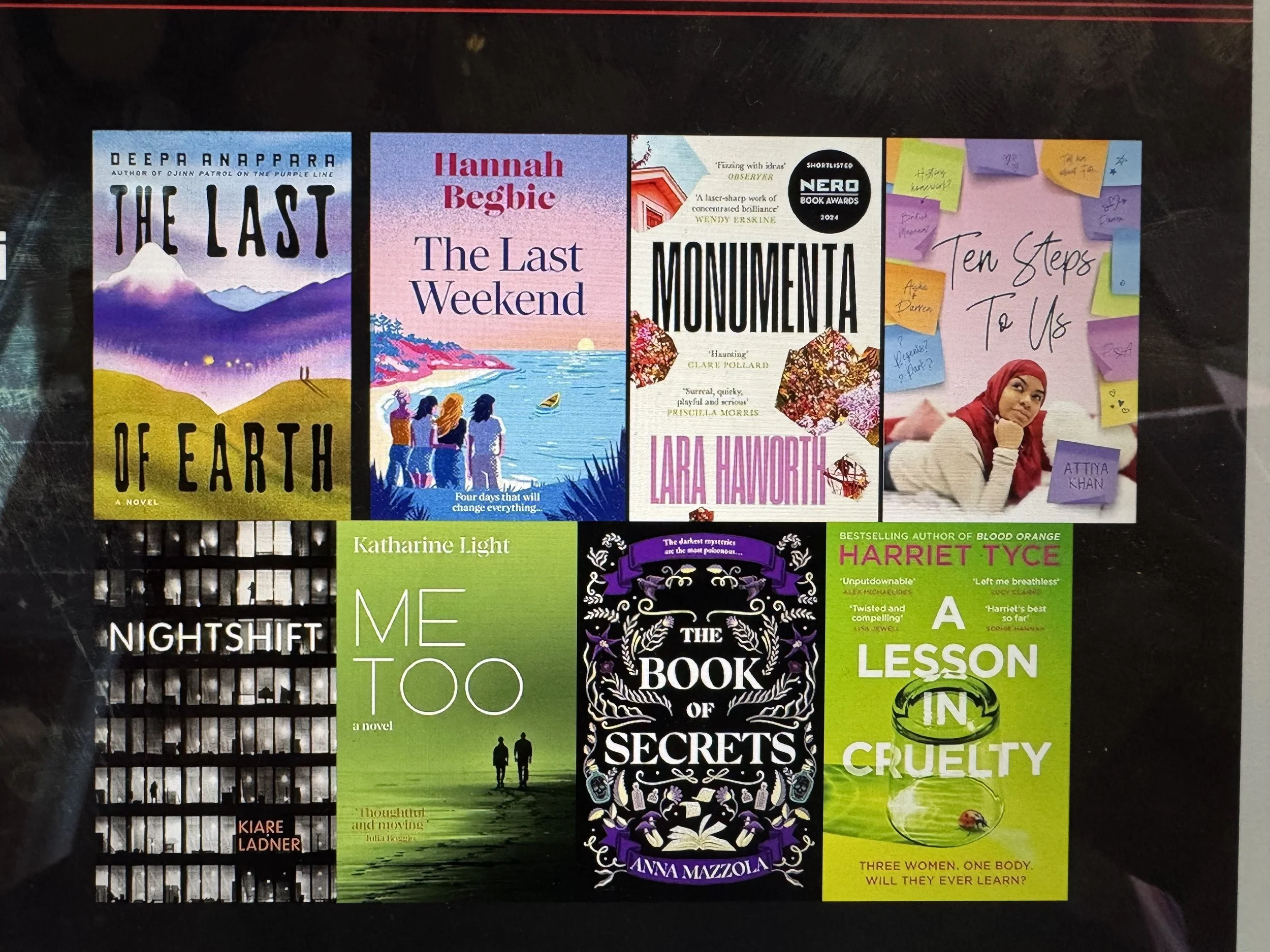
Our alumni track record speaks for itself. Alongside bestselling author of five crime novels, Harriet Tyce, Janice Okoh (last year’s Writers’ Prize judge) has just recently won an emerging talent BAFTA for her screenwriting; Deepa Anappara published her second novel, The Last of Earth, to great critical acclaim earlier this year; and Lara Haworth was shortlisted for the Nero Book Award for her debut, Monumenta.
The deadline has been extended, and there's a giveaway

We've extended our application deadline to 30th June, and to celebrate, we're offering something a little extra. The next ten people to apply will receive a free ticket to our end-of-year showcase — online or in person, your choice — where current Novel Studio students will share their work with an audience of invited industry guests. It's a great evening, and a real taste of what the community is all about.

To apply, email me at Emily.Pedder.1@citystgeorges.ac.uk with 2,000 words of your fiction and a CV detailing any writing experience.
Not quite ready to apply? Come and meet us first.

If you'd like to experience the Novel Studio before you commit, we're running a free one-hour taster session on Thursday 18th June, 12.30–1.30pm BST, via Zoom.

Dr Rebekah Lattin-Rawstrone will lead a mini session on reading like a writer, while Dr Kiare Ladner will explore the art of endings in fiction. There'll also be an overview of the programme and time for your questions.

It's free and online.

Your novel won't write itself, but this course can very much help.

Look forward to seeing some of you at the taster session!

Spotlight on our 2025 Writers' Prize Judge, Janice Okoh

With just ten days left to submit to this year’s Writers’ Prize, we wanted to shine a spotlight on our fabulous judge, Janice Okoh.

Janice Okoh, photography by MAD Photography, Mark Davis

Janice is an award-winning writer whose work spans stage, screen, radio and prose. Her plays include Three Birds, which won the Bruntwood Playwriting Competition, was shortlisted for the Alfred Fagon Award and the Verity Bargate Award, and subsequently adapted for the screen in this year’s BBC3 hit, Just Act Normal. Her debut novel, Girl Number Eight, is forthcoming from Penguin (US) and HarperCollins (UK) in 2027, and she's currently represented by top literary agent Madeline Milburn.

Janice’s hit BBC3 drama, Just Act Normal

As someone who has navigated the journey to publication across multiple mediums, Janice brings invaluable insight to our prize.

We asked Janice to discuss what captures her attention in those opening pages, how working across different forms has shaped her storytelling, and what she's hoping to discover in this year's submissions.

1.    What draws you to a piece of writing in those crucial opening pages – what makes you want to keep reading?

Janice Okoh: What keeps me turning the page is intrigue — Who? What? When? Why? Whether it be emotional or otherwise. In the opening pages there should be at least one question the reader wants to know the answer to. For example, who did it? Why did she give him that look? Why are they not speaking? Some of these questions (called active questions) might be answered by the end of the first chapter or by the tenth. Others might not be answered until the end of the novel.

2.    You've worked across different forms – playwriting, screenwriting, and prose. How has moving between these mediums shaped the way you think about storytelling?

Janice Okoh: When I come up with an idea, I ask myself two questions. The first is what medium would best serve this story and the second is what are the chances of it being produced/published in that medium? 

When I think of ideas for TV, I think more about plot. TV needs a lot of plot. The characters are crucial and I might have a vague idea who they are, but they come afterwards. Once they are formed then they can dictate plot.

In theatre, it’s all about character and dialogue which is exciting. And plot tends to be minimal. The plot could simply be one or two plot twists or revelations.

Prose and radio are the most liberating mediums practically as there are no production costs like location (although with radio the number of characters is always restricted because it’s difficult for the audience to follow) so I save my most ambitious and crazy ideas for those mediums.

3.    The Book Edit Writers' Prize champions underrepresented and unpublished writers. What advice would you give to writers who are still finding their voice or building the confidence to share their work?

 Janice Okoh: You must share your work because doing so can help you progress your work faster, and you can get affirmation whether what you are trying to do is working well. However, only share your work when you’re ready. Sometimes I have shared my work too early and have followed a wrong direction of critiquing because I wasn’t sure of my characters or plot. I now share once I have done a really rough first draft (a zero draft) and have an idea of what I want to say even if the plot or character isn’t quite nailed down. This way, I have my core reason of writing the story to come back to when receiving conflicting critiques or too many opinions. You can weed out the feedback that resonates.

As regards to being an underrepresented writer, seek out underrepresented writer mentors because they’ll usually ‘get’ the nuances of your work. Failing this, find peers who enjoy reading novels, and who read widely, including what is selling well on the market regardless of genre or the background of the author. These peers tend to be good at giving helpful feedback and book reccomendations because they tend to get what you’re trying to do because they have read something like it.

4.    When you're developing a story, whether for stage, screen, or page, what's the element you find yourself returning to most – character, dialogue, structure, or something else entirely?

Janice Okoh: The one-page synopsis. For my second novel I had a one-page synopsis that I tweaked and developed for about a year on and off before I started writing my zero draft. When I start writing my novel, I can refer back to the one-page synopsis of the story so I loosely know what’s coming next. I didn’t work from a one-page synopsis for my first novel and I think this is probably why it took me five years to write as I didn’t have any structure and I wasn’t sure who was telling the story. I was very unsure. I have always written a one-page synopsis when writing radio plays as it’s a requirement for pitching the idea to the radio drama commissioner.

5.    Is there a book, play, or film that profoundly influenced your own approach to writing? What was it about that work that stayed with you?

 Janice Okoh: I would say the play Woolworth Farce by Enda Walsh swept me away because of the intriguing and unique world Walsh created. That play influenced my own early writing and helped me create intrigue. When I think about the play now, I think about how weird it was.

6.    What are you hoping to discover in the submissions for this year's prize? What kind of writing excites you as a reader and judge?

 Janice Okoh: As a reader, I enjoy commercial and literary fiction — from romance, to crime and bookclub. My favourite are novels that hit that sweet spot of having a strong plot but have literary qualities about them. One such book I read recently was Broken Country by Claire Leslie Hall, which blew me away with all its twists and turns and tear-jerking storylines. As a judge, I’m open to any type of genre – I’m aware that romantasy and fantasy are very current so I would not be surprised to find that genre among the submissions. Anything goes really. Just as long as I am swept away by the writing and the plot is intriguing and there are no clichés.

Thank you so much, Janice! We can’t wait to read your debut novel and to find out who you have selected for the prize.

Janice provides bespoke mentoring services for writers and can be contacted via her Substack.


Celebrating Success: Writers Gaining Recognition

There's something particularly rewarding about watching writers who've been part of The Book Edit Writers' Prize community go on to receive wider recognition for their work. Whether our prize was an early stepping stone or one moment among many in their writing journey, it's wonderful to see how these talented writers continue to flourish and gain the recognition they deserve. I wanted to celebrate those achievements during our 2025 prize submission window.

Joe Eurell has been making waves in the crime writing world, recently winning the prestigious CWA Emerging Dagger Award 2025 for his novel Ashland, which won the Writers’ Prize in 2023.

Joe Eurell

Satinder Chohan has just been announced as a winner of the inaugural RSL Scriptorium Award. The Royal Society of Literature's Scriptorium Award winners were chosen by a specially-convened panel of RSL Fellows who gave priority to ‘writers who do not have their own dedicated writing space and who experience barriers to their literary careers.’

Emma Connally-Barklem has published her poetry collection, Car Office, with Written Off Publishing. Emma has also been selected as one of the core poets for the BBC Contains Strong Language Festival coming to Bradford this autumn. This is a significant platform that celebrates the power of spoken word and performance poetry, and it's wonderful to see Emma gaining this recognition for her work.

Emma Connally-Barklem

Serafina Cusack has signed with Sara Langham at David Higham Associates

Serafina Cusack

These achievements illustrate the breadth of talent among the writers who've engaged with our prize and how their creative journeys continue to unfold in new and exciting ways.

Who’s Next?

As we continue welcoming submissions for our 2025 prize (deadline October 13th), I'm excited about discovering this year's cohort of talented writers. With Janice Okoh as our judge, I have no doubt we'll find writers ready to continue their own inspiring journeys.